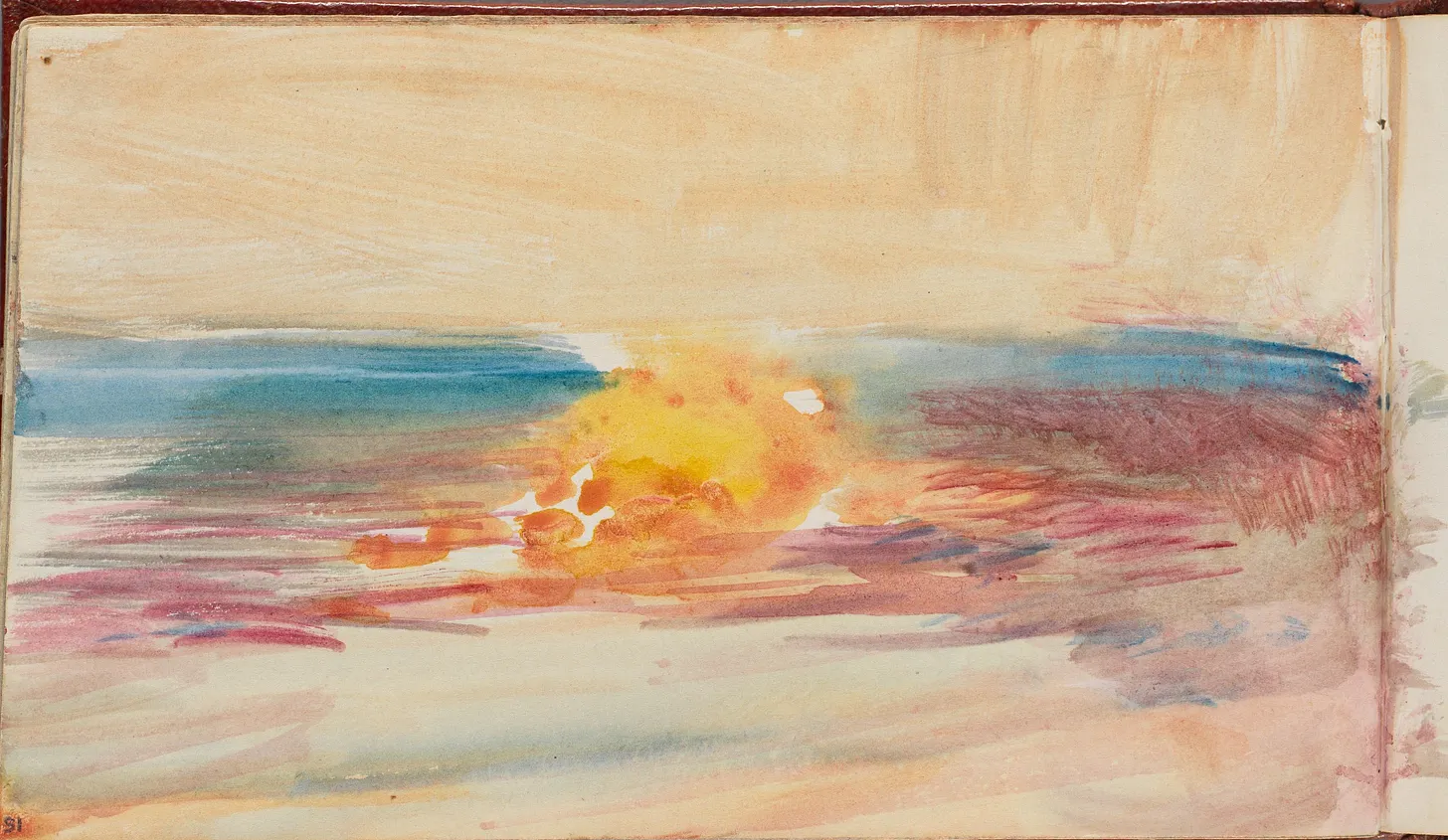
A new house we have built, with this desolation and these wretched hands, a new home.
Imagination has no discernible limits, but it does have limits contingent on subjective variables, ones hidden by our inability to sense a collision with those boundaries, and so, in imagination one finds a perceptible sense of freedom.
This forsakenness that has become a mark on your being, a rejection — you had wished to simply try to stretch your arm outside iron, to make certain that you were alive.
Does one not embody a disgust, when they embody a day in their feudal demesnes?
A self-effacement so grand that it was rightly arrogant, a world-making madness, a world-destroying abnegation.
The sky has no wounds even as it bleeds and weeps, a heaven for the prisoner.
The hope of existential love is self-diminishing, be a mendicant to the self.
Religiosity is not theological seriousness — words and propositions, holy as you make them, vulgar as you make them.
The romantics gathered around the tree, girded in the rippling grass; they sat in silence as they counted first its thin branches, and then its curling leaves.
On the day of their liberty, they stepped out into the terraced opening outside their prison, the golden red sky presented itself with greetings from across the lands.
Leave a note, a trail to follow, in the dark murky forest — in a bottle, the letter had come, what a miracle its arrival on the coast.
One voice, diffracted into a choir of the birds — find the source that was before the fire.
Tend to this garden, with the regularity of medicinal dosage, pruning the weeds lest they overcome life.
Fragility demands attention.
How wondrous that I, you, and they exist.
Dye wool with us, twist, weave, and knit — a walk by the road, same clouds.
In Veranestan, the lake stood exsiccated and the tears of the mothers desiccated, and the clothes remained unwashed.
The ghosts of time past, clutch your shoulder and leave a gash in the night, but at dawn, you forget.
Stacks of paper on his father’s desk, newspapers crisscrossing, borders overreaching one another, the blackness of the coffee twirls slowly, circumambulating with the fan on the ceiling, a smoke in the corner where incense had been burnt.
The sun on your skin a burn again, when you wished to merely yearn again.
Allah Rakha came a long way following the meandering stream to the village of Ghareeban, he had received news that his child was dead, only thirteen years of age, knees still soft and hair still curled as a babe. Allah Baksh, the brother, held the bier along with faceless men. He, too, held a hand to support the weight of his child, but the old fingers felt soft.
In your veins lie no lies now, and the mouth may yet follow, the blood becomes less opaque: an earnestness in the glades of destitution, where once you sang as the bard, crying doleo! at every passerby, what may you sing now?
You struck rules for my soul, and rulers for my head — stand on my toe, sir, crush the tiny fingers of this child, like you have no sons of your own, have no fear for judgement has been postponed.
When he crossed the bridge, between those gray hills on that plateau, his blood knew that it was here, on the day the sky fell into the ground, that he was ravaged, from childness to the depravity of material — a scar on the spine, a mark on the forehead.
He is in past tenses, you in the future, and I the present.
A cathedral built by men not breathing, in a land not theirs, the bellowing bells silent, their echoes never heard in this grey sky, a cathedral of chalk, a congregation of spirits?
In this house we have built, erected on soil made holy for us by rain and sun, in these chastened quarters, the rooms, rooms open unto each other, the alleys merging them long yet short, the walls set in a language only we have known.
And yet, the blood of past time lingers in your spine, dried but carved, you have yet to utter in the box of your cell, miseremini mei!
You burnt this sky made for you, with eyes of a longing only suitable for a passerine on the day of drought.
In the city of Deprimere, there is a man who stores pictures of the world before time, and he waits for the pilgrims to knock on his door, so he may remind them of how it all once was.
Come, do not mind the dust on the pew, son, perhaps, on the day of your crowning, this beggar may muster enough strength to clear away the webs — no matter, come.
When all the colors accrete in the sky, how may you yet repay all the favors laid on you?
When I made pictures of you and the petals that settled around your body, pale yet vital, they asked me to say a few words to tell them how you were, and I said, do you not see, in front of you, in flesh and spirit?
When the mother abandoned the child on the steps of the chapel, she relinquished her rights over the child — for one, the child was to have no mother-tongue, for he would be raised on a diet of cold lentils whose every grain spoke a voice unbeknown to the rest — she took with her the child’s childness, the singularity of its voice, and split it apart into a cacophonous rapture — so when his bones elongated and filled out his spine, the child, now the body, had no course other than to hold all the whispers that haunted him and to grind them together in his palms, left and right, until the pulp was true and right — a milled bridge.
Palobessie’s initial life in the cloud did not hurt as much as it blinded, it took him a year to merely see. Before he knew the cloud, he had merely worked his land, and one day while he was tending to his fields of wheat, an errant man drunk on the liquor of greed stabbed him. Bessie’s blood marked the site of the crime, and it was not long before a cloud found him having descended in search of the corpse.
The cloud took Palobessie all over the lands of the men who lived below unaware of the sky. He saw white plants seated in a jagged circle, gathered in the center of the cloud, on a carpet made of a woven wind. And when the plants cried, the world of men rejoiced for the sake of their crops.
Linobealo had made this cloud his home too, seven years before Palobessie arrived. As fortune would have it, Linobealo had one day tried to peer out the cloud but was unable to bring back his head. Since then, he was never fully home within the cloud.
The plants remained sympathetic to Linobealo, but the trees that grated themselves against one another to create electric charges would kick his caught body, calling him a purgatorial pigeon.
Palobessie wished to reprimand the electricians but the plants warned him that they ran so hot, they could burn the cloud itself when they roared over the men of the land.
It was after twenty-nine years that the cloud spoke to Palobessie, who had simply believed that only its inhabitants had voices.
Why did you take me from my home? What is your name? Why do you speak with me now?
It was not I that took you, but you that called me, nay, cried for me as you lay in your bloody field. The other clouds call me Thikokaldin, but you may call me Bobo, and as for why, it took me time to know you, and I do not speak or act before I know.